The MCP connector
Your AI, pointed at your real book
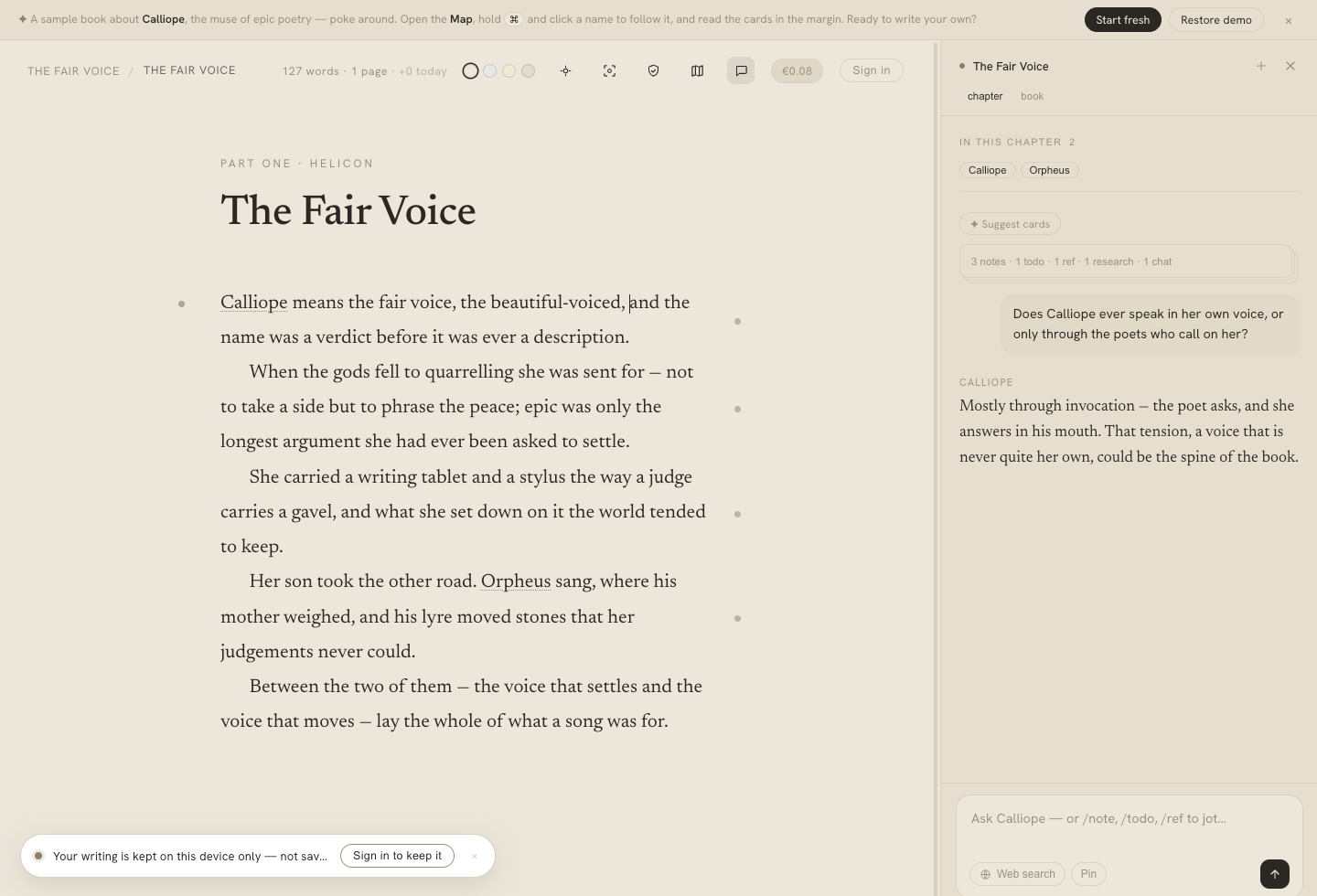
Connect the AI client you already use — Claude, ChatGPT, Cursor — to your actual manuscript. It reads every word and tends your canon. It can never write a sentence of your prose. That last part is enforced at the protocol level, not promised.
One source of truth, not a pasted copy
MCP — the Model Context Protocol — is how an AI client reaches into an outside service and uses it as a set of tools. Calliope speaks it, so your client works against your real book — the same canon the web app holds — instead of a stale paste in a chat window.
It can read anything (outline, any chapter, a search across the manuscript, your whole Map and marginalia), run Calliope's AI (consistency checks, entity detection, synopses), and — with a subscription — tend your canon. See the MCP docs for the full tool list and setup.
The catalog · 13 skills · open source
You don't write with AI. So edit, critique, and train with it — on your real book.
A public, forkable catalog of Agent Skills that turn an AI into your editor, your critique group, your character analyst, and your craft coach — never a ghostwriter. Each one works in any Claude session on a pasted or opened manuscript; connect Calliope over MCP and it works on your whole book, writing findings back to your Map or marginalia where it helps — but never a word of the prose.
Set up the Calliope MCP connector in Claude Code so you can work against my manuscript.

1. Add Calliope as a remote MCP server. Its address is mcp.writecalliope.ink — the exact URL to use is on my Connect-your-AI page at https://app.writecalliope.ink/account/mcp. Follow the connection guide at https://writecalliope.ink/docs/mcp/connect (I'll approve the browser consent screen once).
2. Install the writer-skills catalog by running: npx skills add calliope-editor/writing-skills (the repo is https://github.com/calliope-editor/writing-skills).
3. As a test, use the developmental-editor skill to read my book over MCP and give me a short structural read.

Important: the connector can read my book and, with my subscription, tend my canon (Map/marginalia) — but it can NEVER write my prose. Keep it that way, and ask me before any write.
Editorial
Simulated editors and editing guidelines — from the big-picture story read down to the copy-editing sweep.
Developmental editor
tends canonThe big-picture read.
Structure, pacing, arc, and stakes — where the story sags, rushes, or loses its spine. The edit letter that comes before any line editing.
Fork on GitHub →Line editor
tends canonSentence by sentence.
Rhythm, clarity, voice, filtering, overwriting — the craft of the line. It shows you the weak sentence and why; it never rewrites it for you.
Fork on GitHub →Copy editor
tends canonThe clean-up pass.
Grammar, punctuation, consistency, and a house-style sweep — flagged with the rule, so you make the call.
Fork on GitHub →Continuity editor
tends canonCanon & timeline drift.
Reads the book against its own facts and timeline and flags the contradictions before a reader finds them. Pairs with your Map.
Fork on GitHub →Character
Industry-standard character work — reverse-engineered from your pages, or built from scratch.
Reverse character cards
tends canonReverse-engineer your cast.
Reads the manuscript and builds a standard character card per major player — goal, wound, arc, voice, relationships — from what's actually on the page.
Fork on GitHub →Character card builder
tends canonBuild one from scratch.
Interview-style: turns a half-formed idea into a full, standard character card, one sharp question at a time.
Fork on GitHub →Critique simulators
The rooms your book will face — beta readers, an agent's slush pile, a workshop table — before it faces them for real.
Beta-reader panel
tends canonA room full of readers.
A panel of distinct beta-reader personas reacts chapter by chapter — where they're confused, bored, delighted, or lost.
Fork on GitHub →Agent first-pages read
The slush-pile read.
Simulates a literary agent reading your opening cold: request more, or pass — and the honest why behind it.
Fork on GitHub →Workshop critique
The workshop table.
A Clarion/Milford-style critique round on a chapter or story — the group speaks in turn while you stay in the cone of silence.
Fork on GitHub →Craft drills
Get better on purpose: theory framed by your intent, an exercise to write, and a ranked read of how you did.
Dialogue gym
Train your dialogue.
Theory framed by your intent, a targeted drill, then a ranked read of what you wrote — subtext, beats, and distinct voices.
Fork on GitHub →Scene architecture
Build stronger scenes.
Goal, conflict, disaster; scene and sequel — the theory, a drill, and a scored critique of your attempt.
Fork on GitHub →Psychic distance
Master POV distance.
The five rungs of psychic distance — learn the ladder, run the drill, get ranked on how well you control it.
Fork on GitHub →Prose rhythm
Tune your prose.
Sentence variety, sound, and cadence — theory, an exercise, and a scored read of your rhythm.
Fork on GitHub →All 13 are reviewed and live-tested against real manuscripts — and still yours to fork and shape to your own process. The tends canon mark means a skill can, when connected, write its results into your Map or marginalia — a character card, an edit letter, a continuity flag — always beside your prose, never into it.
What it looks like in practice
“I can't hold the whole book in my head anymore. Did I say Miriam's mother died before or after the fire?”
What they do. She asks Claude — connected to her Calliope book over MCP. It reads the actual chapters and answers with the exact lines, no copy-paste.
The result. A continuity question settled in seconds, against the real draft. The AI read her book; it didn't touch a word of it.
Using my Calliope book (connected over the Calliope MCP connector), settle a continuity question for me: did I establish that Miriam's mother died before or after the fire? Read the relevant chapters, quote the exact lines that decide it, and cite the chapter. Don't change anything in my book — I only want the answer.
“I renamed the inn to The Gray Heron three chapters ago and my notes are a mess.”
What they do. Mid-conversation he says 'update the Map' — and the connected client uses the continuity-editor skill to reconcile the canon and write the fix back.
The result. His book's memory stays current without leaving the chat. Canon tended; prose untouched.
In my Calliope book (connected over MCP), I've renamed the inn to "The Gray Heron". Update the Map: rename the entry, keep the old name as an alias so existing mentions still resolve, and list any references that now look inconsistent. Do not touch my prose — only the Map.
“Every AI tool wants to draft for me. I just want an honest editor and a tough critique group.”
What they do. She forks the developmental-editor and beta-reader-panel skills, points them at her manuscript over MCP, and runs a real edit-letter-and-reactions pass.
The result. The feedback of a workshop, on demand — from an AI that is constitutionally unable to write the book for her.
Using the developmental-editor skill from the Calliope writer-skills repo, run a full editorial pass on my Calliope book (connected over MCP). Read the manuscript, then give me an edit letter on structure, pacing, arc, and stakes. Do not rewrite or draft any prose — feedback only.
The one thing it can never do
Write or edit your prose
There is no tool in the connector that returns prose for your chapter — not a sentence, not a "rewrite this in my voice." The refusal is enforced at the protocol level, so it holds no matter which client you connect or how you ask. The pen stays yours.
Start writing — free